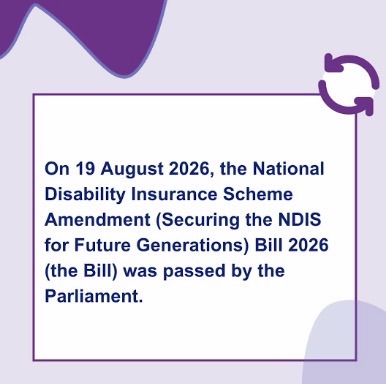
The NDIS Amendment (Securing the NDIS for Future Generations) Bill 2026 passed Parliament on 19 August. While implementation will occur progressively, the direction of travel is becoming increasingly clear: the NDIS is moving toward a system more tightly focused on permanent and significant disability, functional capacity and demonstrated support need. (VicHealth)
For allied health organisations—particularly those with a significant paediatric caseload—this is not something to watch from the sidelines. It requires planning now.
👧 THRIVING KIDS WILL CHANGE THE PAEDIATRIC LANDSCAPE
From 1 January 2028, children aged 8 and under with developmental delay and/or autism and low-to-moderate support needs will increasingly be supported outside the NDIS through Thriving Kids and mainstream/foundational supports. Children with permanent and significant disability, including children with substantially reduced functional capacity and high support needs, will remain eligible for the NDIS. (VicHealth)
Thriving Kids itself begins rolling out from October 2026, with full implementation planned by January 2028. Governments have committed up to $4 billion over five years to the initiative. (VicHealth)
Importantly, this does not mean allied health disappears.
The national model specifically includes targeted supports such as Speech Pathology, Occupational Therapy, Psychology and other allied health interventions, delivered individually, in groups and in the everyday environments where children live, learn and play. (VicHealth)
What may change significantly is how those services are accessed, commissioned, delivered and paid for.
Health Minister Mark Butler has specifically indicated that allied health professionals currently working intensively with children through the NDIS will continue to have an important role—but potentially through different settings and funding/commissioning arrangements. (VicHealth)
For providers, that distinction is enormous.
📊 DIAGNOSIS ALONE WILL NOT BE THE STORY — FUNCTION WILL MATTER
From 1 January 2028, NDIS access is intended to move toward a standardised, evidence-based assessment of functional capacity.
The focus will increasingly be:
How significantly does a person’s disability affect their ability to function in everyday life?
A Technical Advisory Group is currently informing the thresholds and assessment framework, so we should be cautious about claiming exactly what the final assessment tools or thresholds will look like. (VicHealth)
There is also an important distinction between access assessments and the new Support Needs Assessment.
From April 2027, new framework planning is expected to use a Support Needs Assessment considering functional capacity, life stage and environmental factors to inform plan budgets. The Government states this assessment will determine support needs and budgets—not NDIS access itself. (VicHealth)
For clinicians, this reinforces something good allied health practice should already be doing:
Assess the person, not simply the diagnosis.
Reports will increasingly need to clearly articulate functional impact, participation, environmental barriers, capacity, support requirements and measurable outcomes—not simply provide a diagnostic label or list of therapy recommendations.
🏢 WHAT DOES THIS MEAN FOR ALLIED HEALTH BUSINESSES?
For organisations heavily dependent on paediatric NDIS therapy, there is genuine business risk.
But there is also opportunity.
The demand for quality allied health isn’t disappearing. The funding pathways are changing.
Future-focused providers should be considering diversification now:
➡️ NDIS therapy for people with permanent and significant disability
➡️ Thriving Kids and future government-commissioned programs
➡️ Medicare and private allied health services
➡️ School and early-childhood partnerships
➡️ Group-based intervention and capacity-building programs
➡️ Parent/carer coaching and education
➡️ Clinical supervision
➡️ Employee Assistance Programs
➡️ Workplace mental health and wellbeing
➡️ Training and professional development
➡️ Behaviour support and specialist disability services
➡️ Community, health and government contracts
➡️ Telehealth and regional service delivery
The organisations most exposed to reform will be those whose client base, workforce and revenue are almost entirely dependent on one government funding stream.
Diversification isn’t abandoning the NDIS.
It is building a sustainable organisation capable of continuing to support people regardless of how government policy changes.
💡 THERE IS ALSO AN OPPORTUNITY TO RETHINK HOW WE DELIVER THERAPY
Thriving Kids points toward intervention that is family-centred, capacity-building, outcomes-focused and delivered within children’s everyday environments.
The Advisory Group recommended targeted supports that can include one-to-one allied health, group intervention, family capacity building and assistance around transitions such as commencing preschool or school. (VicHealth)
For innovative providers, this creates opportunities to develop scalable, evidence-informed programs rather than relying exclusively on the traditional one clinician + one child + one billable hour model.
🌱 OUR SECTOR NEEDS TO PREPARE — WITHOUT PANICKING
There remains significant detail to be determined.
We don’t yet know every commissioning arrangement, assessment tool, provider pathway or state-based implementation model.
So this isn’t a prediction that paediatric allied health or the NDIS is disappearing.
Far from it.
It is recognition that the disability and allied health landscape is undergoing structural change.
For providers, now is the time to:
Diversify. Innovate. Measure outcomes. Strengthen clinical governance. Build partnerships. Understand functional assessment. Develop services outside the NDIS. And most importantly—keep participants, children and families at the centre of every decision.
Sustainable providers create sustainable services.
And sustainable services mean children, families and people with disability can continue receiving quality support—regardless of what the next reform brings.
#NDIS #NDISReform #ThrivingKids #AlliedHealth #Disability #EarlyIntervention #Paediatrics #SpeechPathology #OccupationalTherapy #Counselling #PositiveBehaviourSupport #FunctionalCapacity #NDISProviders #Healthcare #BusinessSustainability #FoundationalSupports