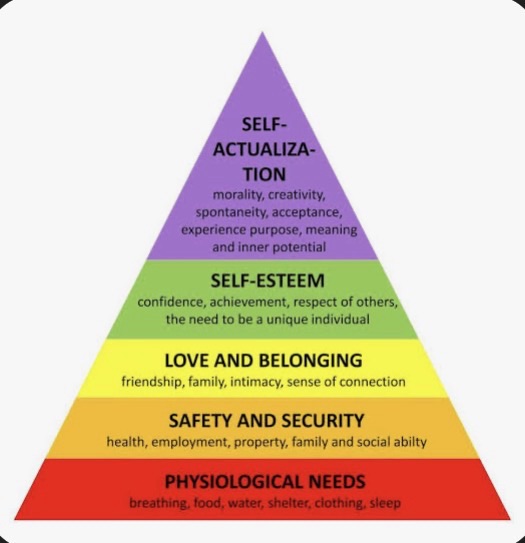
Abraham Maslow proposed that human motivation is driven by a hierarchy of needs. While it’s often taught as a simple pyramid, its real power shows up in relationships—especially when couples or families feel stuck, disconnected, or stuck in recurring conflict.
At its core, Maslow’s theory reminds us of this truth:
We cannot build healthy, secure relationships when our most basic needs are unmet.
Let’s break this down layer by layer and explore how it plays out relationally.
1. Physiological Needs
(Food, sleep, rest, health, physical regulation)
These are survival needs—but in relationships, they’re often quietly ignored.
How this shows up in relationships:
Chronic exhaustion leading to irritability or emotional shutdown One partner doing all the emotional labour while running on empty Conflict escalating simply because both people are dysregulated
When someone is sleep-deprived, unwell, or overwhelmed, their nervous system is in survival mode. In this state, empathy drops, patience shortens, and communication suffers.
Relational insight:
You can’t “talk your way” out of conflict when someone’s body is screaming for rest.
2. Safety Needs
(Emotional safety, financial security, predictability, trust, boundaries)
This is where many relationship breakdowns truly begin.
How unmet safety looks:
Walking on eggshells Fear of abandonment or rejection Financial stress dominating conversations Emotional unpredictability or explosive reactions
Without safety, the brain stays hyper-alert. People become defensive, controlling, avoidant, or emotionally reactive—not because they want to be difficult, but because their system doesn’t feel safe.
Relational insight:
Connection cannot grow in an environment where someone feels unsafe—emotionally, psychologically, or physically.
3. Love and Belonging
(Connection, intimacy, acceptance, attachment)
This is the level most people think relationships are “about”—but it’s impossible to sustain if the layers below are unstable.
When belonging is disrupted:
Feeling lonely even while partnered Seeking validation outside the relationship Clinging, withdrawing, or testing the relationship Repetitive arguments about “not feeling heard” or “not feeling important”
Humans are wired for connection. When this need isn’t met, people often protest for closeness in unhealthy ways—criticism, withdrawal, jealousy, or emotional shutdown.
Relational insight:
What looks like “neediness” is often an unmet belonging need.
4. Esteem Needs
(Self-worth, confidence, respect, competence)
Esteem is both internal and relational.
In relationships, low esteem can look like:
Over-dependence on a partner for validation Power imbalances Fear of speaking up or setting boundaries Constant comparison or defensiveness
When someone doesn’t feel good enough, they may seek reassurance endlessly—or push their partner away before they can be rejected.
Relational insight:
Healthy relationships are built between two people who feel worthy—not perfect, but secure enough to be seen.
5. Self-Actualisation
(Growth, purpose, meaning, authenticity)
This is where relationships thrive—not just survive.
At this level:
Partners support each other’s growth Conflict is navigated with curiosity rather than threat Individuals feel free to be authentic The relationship becomes a place of expansion, not containment
But self-actualisation cannot be forced. It naturally emerges only when the foundational needs are solid.
Relational insight:
You can’t grow together if you’re still fighting to feel safe or seen.
Why This Matters in Therapy and Real Life
In relationship work, people often try to fix communication without addressing regulation, safety, or basic needs.
Maslow’s model reminds us to ask better questions:
Are both people regulated enough to connect? Does this relationship feel emotionally safe? Are basic needs being overlooked in the name of “working on the relationship”?
When we address the right level of need, change becomes possible—and sustainable.
Final Thought
Healthy relationships aren’t built by willpower or love alone.
They’re built when human needs are understood, respected, and met—layer by layer.
Sometimes the work isn’t “trying harder”…
It’s starting lower on the pyramid.