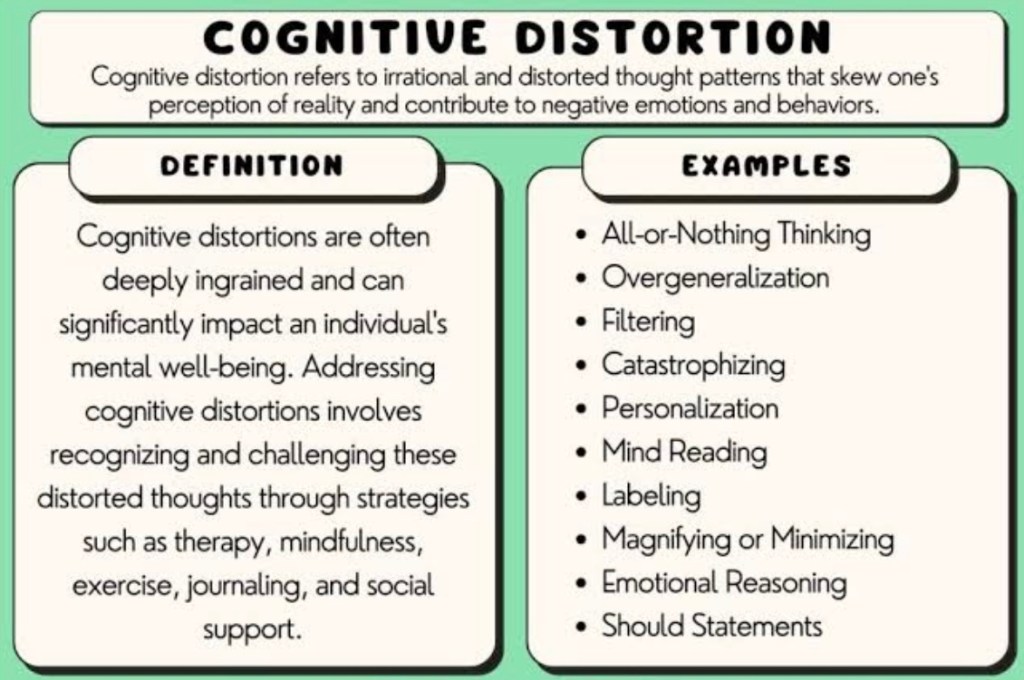
In the intricate web of the human mind, cognitive distortions act as invisible threads that can skew our perception of reality. These irrational thoughts, such as black-and-white thinking, emotional reasoning, fortune telling, mind reading, catastrophizing, and overgeneralization, can significantly impact our emotions and behavior, leading to unnecessary stress and challenges. In this exploration, we’ll dissect these distortions and provide practical tips on navigating the complex landscape of the mind.
1. Defining Cognitive Distortions:
Cognitive distortions are systematic patterns of thought that consistently reinforce negative beliefs. Black-and-white thinking oversimplifies situations, emotional reasoning lets feelings dictate reality, and fortune telling and mind reading involve making negative predictions or assumptions about the future or others.
2. Types of Cognitive Distortions:
a. Catastrophizing:
Expecting the worst possible outcome, catastrophizing often involves envisioning exaggeratedly negative scenarios, contributing to anxiety and stress.
b. Overgeneralization:
This distortion arises when a single negative event is perceived as a never-ending pattern of defeat, leading to a pessimistic outlook on future situations.
c. Filtering:
Focusing solely on the negative aspects of a situation while ignoring any positive elements characterizes filtering, intensifying feelings of dissatisfaction.
d. Emotional Reasoning:
Emotional reasoning occurs when feelings, not facts, dictate thoughts and actions. For example, assuming something is true because it feels true, even in the absence of supporting evidence.
e. Fortune Telling:
Fortune telling involves predicting negative outcomes without concrete evidence. Individuals may convince themselves that a situation will end poorly, even when there’s no factual basis for such predictions.
f. Mind Reading:
Mind reading is the distortion of assuming we know what others are thinking, often attributing negative thoughts or intentions to them without evidence.
3. Strategies to Combat Cognitive Distortions:
a. Reality Testing:
Engage in reality testing by examining the evidence supporting or contradicting your thoughts. This involves objectively evaluating whether your assumptions align with the actual facts of a situation.
b. Behavioral Activation:
Combat distortions by engaging in positive behaviors that challenge negative thought patterns. Taking proactive steps towards your goals can disrupt the cycle of distorted thinking.
c. Gratitude Practice:
Cultivate a gratitude practice to shift focus from negativity to positivity. Regularly acknowledging and appreciating positive aspects of your life can counteract cognitive distortions by fostering a more optimistic mindset.
d. Self-Compassion:
Develop self-compassion as a countermeasure to harsh self-judgment. Treat yourself with kindness and understanding, recognizing that everyone experiences challenges and imperfections.
In the intricate tapestry of the mind, cognitive distortions intertwine to influence our perception of the world. By recognizing and addressing distortions like emotional reasoning, fortune telling, and mind reading, along with implementing strategies such as reality testing, behavioral activation, gratitude practice, and self-compassion, we can unravel these invisible threads and navigate a path to clearer thinking. Through mindfulness, thought challenging, and embracing balanced perspectives, we can foster resilience and cultivate a more accurate understanding of the complex terrain within our minds.