Introduction
Understanding the intricate relationship between thoughts, feelings, and behaviors has been a focal point in psychological research for decades. Cognitive Behavioral Therapy (CBT) leverages this triad, positing that our thoughts significantly influence our emotions and behaviors. This blog delves into the scientific foundation underpinning this relationship, exploring how cognitive processes shape our emotional experiences and actions without delving into the therapeutic specifics of CBT itself.
The Cognitive-Emotional-Behavioral Model
The Role of Cognition
Cognition encompasses the mental processes involved in gaining knowledge and comprehension, including thinking, knowing, remembering, judging, and problem-solving. Research in cognitive psychology has demonstrated that our thoughts—both conscious and unconscious—are central to how we interpret and interact with the world.
Evidence from Cognitive Psychology
A seminal study by Beck (1967) laid the groundwork for understanding cognitive distortions and their role in emotional disturbances. Beck’s research showed that negative automatic thoughts contribute significantly to emotional disorders such as depression and anxiety. For instance, individuals prone to depressive thoughts often exhibit patterns of cognitive distortions, such as catastrophizing or overgeneralizing, which in turn exacerbate their emotional distress.
Further research by Clark and Beck (1999) expanded on this, illustrating that maladaptive cognitive schemas—enduring and pervasive patterns of thought—underpin many emotional disorders. These schemas shape how individuals perceive themselves, others, and the future, creating a self-reinforcing loop that perpetuates negative emotions.
Emotions: The Response to Cognition
Emotions are complex reactions that involve physiological arousal, expressive behaviors, and conscious experience. While emotions can arise from non-cognitive sources (e.g., hormonal changes, neurochemical imbalances), a substantial body of evidence indicates that cognitive processes play a critical role in the genesis and modulation of emotional responses.
Research on Emotion Generation
Lazarus’s (1991) appraisal theory of emotion posits that cognitive appraisal—or the personal interpretation of a situation—precedes and triggers emotional responses. According to Lazarus, how an individual appraises an event (as threatening, challenging, or benign) determines their emotional reaction. This theory is supported by numerous studies demonstrating that reappraisal or changing one’s thought about a situation can significantly alter emotional outcomes (Gross & John, 2003).
Neuroscientific research also supports the cognitive basis of emotion. Functional magnetic resonance imaging (fMRI) studies have shown that cognitive processes can influence activity in the brain’s emotional centers, such as the amygdala. Ochsner et al. (2002) found that when individuals engage in cognitive reappraisal, they exhibit decreased activation in the amygdala and increased activation in the prefrontal cortex, indicating a top-down regulation of emotion through cognition.
Behaviors: The Outcome of Thoughts and Feelings
Behavior, the observable actions of individuals, is often driven by an interplay of cognitive and emotional processes. Behavioral psychology has long studied the relationship between stimuli, responses, and reinforcements, but cognitive psychology has enriched this understanding by elucidating how internal processes guide behavior.
Cognitive-Behavioral Links
Ajzen’s (1991) Theory of Planned Behavior (TPB) integrates cognition and behavior by proposing that behavioral intentions, shaped by attitudes, subjective norms, and perceived behavioral control, predict actual behavior. This theory emphasizes the role of cognitive factors (e.g., beliefs and intentions) in determining how likely an individual is to engage in a particular behavior.
Empirical studies have consistently shown that altering cognitive appraisals can lead to changes in behavior. For instance, research on health behaviors (e.g., smoking cessation, exercise adherence) indicates that cognitive interventions aimed at modifying beliefs and attitudes about these behaviors can significantly impact individuals’ actions (Webb & Sheeran, 2006).
Integrated Model: Thoughts, Feelings, and Behaviors
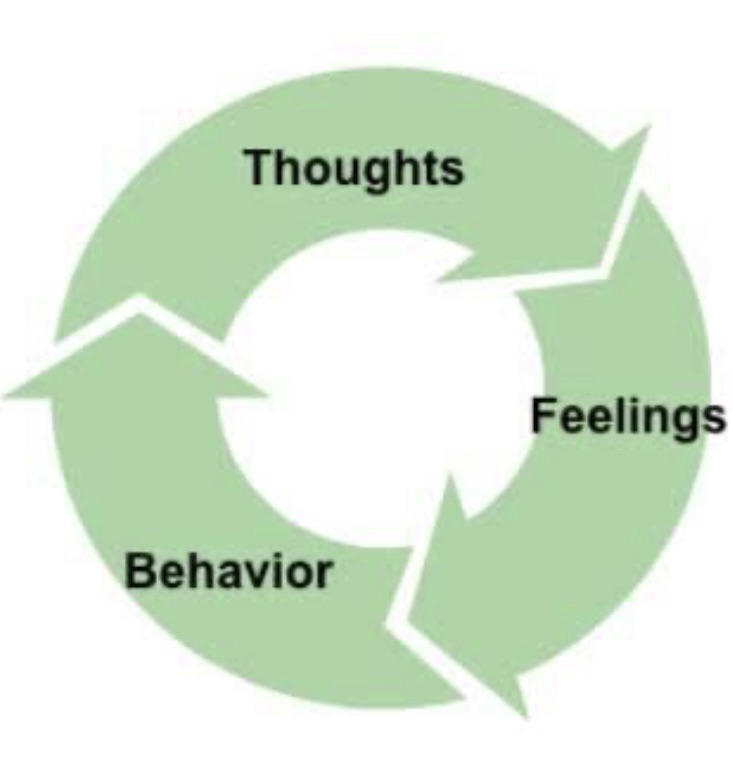
The interconnection between thoughts, feelings, and behaviors is often depicted as a dynamic and reciprocal relationship. Cognitive Behavioral models assert that these components influence each other in a continuous feedback loop. For example, negative thoughts can lead to feelings of sadness or anxiety, which may result in avoidance behaviors. These behaviors, in turn, can reinforce the initial negative thoughts, creating a cycle that can be difficult to break.
Supporting Evidence
Numerous studies support the notion of a reciprocal relationship between cognition, emotion, and behavior. For instance, a study by Teasdale (1983) on depression highlighted how negative thinking patterns (cognitions) lead to depressive symptoms (emotions), which then influence behaviors such as social withdrawal and inactivity. These behaviors subsequently reinforce the negative thoughts, perpetuating the depressive cycle.
Similarly, research on anxiety disorders (e.g., panic disorder, social anxiety disorder) indicates that maladaptive thoughts about feared situations (e.g., “I will embarrass myself”) lead to anxiety (emotion) and avoidance (behavior). This avoidance behavior prevents individuals from disconfirming their negative beliefs, thus maintaining the cycle of anxiety (Clark & Wells, 1995).
Mechanisms of Cognitive Influence
Understanding the mechanisms through which thoughts influence feelings and behaviors requires an exploration of several cognitive processes:
Attention and Perception
Attention and perception are foundational cognitive processes that determine how we filter and interpret information from our environment. Research shows that individuals with anxiety or depression often exhibit attentional biases towards negative stimuli (Mathews & MacLeod, 2005). This selective attention can amplify negative emotions and influence behaviors such as avoidance or rumination.
Memory
Memory, especially autobiographical memory, plays a crucial role in shaping our emotional responses and behaviors. Individuals with depression often recall negative memories more readily than positive ones (Williams et al., 2007). This biased recall can perpetuate negative emotional states and influence behaviors based on past experiences.
Cognitive Control
Cognitive control, including processes such as inhibition and cognitive flexibility, allows individuals to regulate their thoughts and emotions. Effective cognitive control can mitigate the impact of negative thoughts on emotions and behaviors. For example, individuals with strong cognitive control can reframe negative thoughts more effectively, leading to more adaptive emotional and behavioral responses (Hofmann et al., 2012).
Conclusion
The intricate interplay between thoughts, feelings, and behaviors is a cornerstone of psychological science, underpinning much of our understanding of human functioning. Cognitive processes shape how we interpret and react to the world, influencing our emotional experiences and guiding our behaviors. Empirical research across various domains—cognitive psychology, neuroscience, and behavioral science—provides robust evidence for the centrality of cognition in driving emotions and actions.
This understanding not only advances our knowledge of human behavior but also informs therapeutic approaches, such as CBT, that leverage these cognitive-emotional-behavioral connections to foster psychological well-being. As research continues to unravel the complexities of these interactions, the potential for developing more effective interventions to enhance mental health and adaptive functioning grows ever more promising.
In summary, the science behind thoughts, feelings, and behaviors reveals a dynamic and reciprocal relationship that underscores the power of cognition in shaping our emotional and behavioral lives. Understanding and harnessing this relationship holds the key to unlocking profound changes in how we think, feel, and act, ultimately leading to healthier and more fulfilling lives.
 The Veteran Counsellor Blog